
![BUSY SEASON Christy Loewen, pictured left, and Eric Gajar, pictured right, read an application for the next year. “A lot of people ask, what does it take to be admitted?” said Gajar. “We are first and foremost a college prep school, so we want people who can handle that, but [who] also are good citizens to have as a part of the community.”](https://greenhillsalcove.com/wp-content/uploads/2026/02/image.jpg)

![BE OUR GUEST Greg Huntoon performed as Gaston in the Burns Park Players’ community production of “Beauty and the Beast,” in 2023. “[When] you are somewhere else in the world, and [someone] says, ‘Oh my gosh you were Gaston,’ It's funny,” said Greg.](https://greenhillsalcove.com/wp-content/uploads/2026/01/Screenshot-2026-01-09-at-11.10.29-AM.png)

Throughout American history, students have often been told to wait their turn. We’ve been told we’re too young, too inexperienced, too emotional. And yet, time and time again, it has been students who have pushed the country forward when those in power refused to act. From Civil Rights sit-ins to Vietnam War demonstrations to today’s protests against deportation policies and human rights abuses, students’ voices have filled each corner of our country, demanding to be heard.
That truth became real to me as I marched alongside my peers, shouts filling the air around me. I remember looking around, trying to memorize every detail: the signs held overhead, the chants echoing back and forth, the sheer number of people showing up because they believed something was wrong. There was a kind of energy in that moment that’s difficult to put into words. It was anger, outrage, solidarity, and the overwhelming feeling of hope. It was the feeling of standing next to people who cared enough to show up.
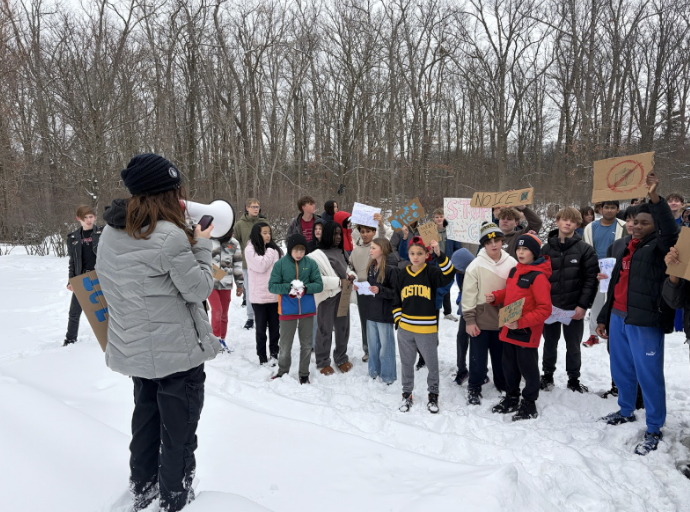
Over the past week, I attended two anti-ICE protests. The first took place at Plymouth-Canton Educational Park, where I marched alongside former classmates and complete strangers. We gathered under the shared belief that immigration enforcement policies were harming people and families. A helicopter hovered overhead while teachers and security stood on the sidelines. There were chants calling for ICE to be abolished, signs reading “No one is illegal on stolen land,” and counter-protesters shouting back with Trump slogans and claims that ICE “protects us”.
At times, the atmosphere felt tense. I found myself looking over my shoulder to make sure my sister and friend were close by in fear of a fight breaking out. Some students were warned of suspension for standing on others’ shoulders. Student agitators moved through the crowd, while Bible readers preached and Trump supporters attempted to provoke reactions.
The protest at Greenhills looked different than the first. As a smaller school, I expected to feel that difference, but when I approached the gathering point, I saw the area flooded with people. Students left class together, some carrying handmade signs, and walked in a loop around the track before eventually heading back inside. When we gathered indoors, one student gave a speech, reminding us why we were there and what we were standing for. Although the protest wasn’t as loud or dramatic, there is something to be said about students breaking routine when they decide they don’t want to remain silent anymore. The community our school offers made it easier for those nervous about speaking out to do so alongside friends and classmates.
Beyond protesting, I took additional steps that felt just as important. I called my state senators and my representative as a future constituent voting in the 2026 midterms, urging them to prevent increased funding towards ICE. Those phone calls were short, scripted, and slightly uncomfortable, but they mattered. Protests alone raise awareness, but action alongside protest pressures change.
As a minor, unable to vote, it can feel nearly impossible to confront injustice. We watch adults in power dismiss student voices as naive or misinformed. We are told that our anger is misplaced, that we don’t understand how the “real world” works. But this is still the United States of America, a country rooted, at least in theory, in democracy. Our congressmen and congresswomen rely on constituents to stay in office. They may try to make us feel powerless, but the reality is the opposite. We hold power not because of our age, but because of our collective voice.
Many students believe that simply participating in a protest won’t lead to real change. History proves otherwise. During the Civil Rights Movement, sit-ins led by students challenged segregation in public spaces and helped push forward landmark legislation. In the 1960s and 70s, students across the country protested the Vietnam War, expressing widespread distrust and outrage that ultimately shifted public opinion and political decision-making. These movements worked not because of one individual, but because people united and refused to stay silent.
Modern student protests follow that same tradition, whether they are against ICE, for Palestinian human rights, or for racial and gender justice. They are not about causing disruption for attention. They are about humanity. About asking why “liberty and justice for all” so often excludes the most vulnerable. About exercising our First Amendment rights not out of rebellion, but responsibility.
Student protests are rarely perfect. They can be overcrowded, disorganized, and emotionally charged. But imperfection does not negate impact. Showing up still matters. Speaking out still matters. Making phone calls, writing letters, holding signs, chanting in unison; each action builds pressure that those in power cannot ignore forever.
There will always be a need for people to take action against injustice, regardless of the social climate. And as long as injustice exists, people will continue to speak up and speak out for what they believe in. Protesting is about refusing to accept silence when human rights are at stake. Showing up, raising your voice, and demanding change are not radical acts, they are democratic ones.