

![BUSY SEASON Christy Loewen, pictured left, and Eric Gajar, pictured right, read an application for the next year. “A lot of people ask, what does it take to be admitted?” said Gajar. “We are first and foremost a college prep school, so we want people who can handle that, but [who] also are good citizens to have as a part of the community.”](https://greenhillsalcove.com/wp-content/uploads/2026/02/image.jpg)





![BE OUR GUEST Greg Huntoon performed as Gaston in the Burns Park Players’ community production of “Beauty and the Beast,” in 2023. “[When] you are somewhere else in the world, and [someone] says, ‘Oh my gosh you were Gaston,’ It's funny,” said Greg.](https://greenhillsalcove.com/wp-content/uploads/2026/01/Screenshot-2026-01-09-at-11.10.29-AM.png)


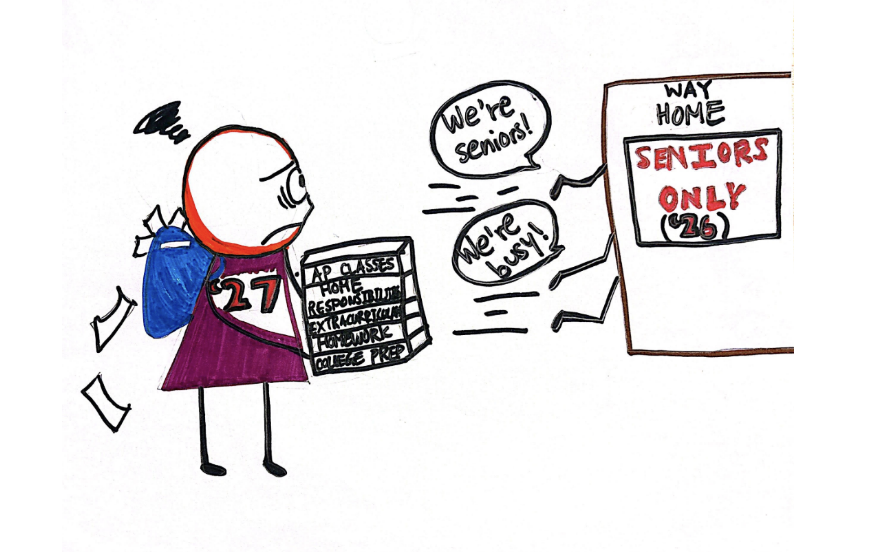
It’s 2:50 p.m., officially the end of school. You let out a sigh as you pack your backpack and wrap up the day — but instead of heading home to catch up on work, rest, or grab a coffee, you’re forced to sit in the study hall, staring at the clock, waiting for 3:20 to finally arrive. The seniors are long gone, free to leave campus once their classes end. Meanwhile, juniors — who are just as tired, just as responsible, and arguably even busier — are encouraged to stay put.
At many schools, senior privileges are a long-standing tradition. They’re meant to reward students for their years of hard work and maturity, giving them a small taste of freedom before college. But the truth is, juniors have earned that same level of trust: by junior year, students have already proven themselves capable of handling adult responsibilities. They manage rigorous schedules filled with AP courses, standardized testing, extracurricular commitments, and leadership positions. Many even drive themselves to school, work part-time jobs, and balance family obligations. The notion that juniors require stricter supervision than seniors, simply on the fact that they aren’t seniors yet is not only unfair, it’s illogical.
When I was a junior myself, I remember feeling very frustrated about this entire system. I remember days when my schedule ended early, but I stayed in study hall because that was the “expectation.” I’d sit there, exhausted, thinking about how much more productive I could be if I could just go home — to study, to rest, or even to breathe. That time could’ve been used meaningfully, but instead it was wasted in the name of consistency. Even getting a few extra hours of sleep when I had a free period as my first “class” would have been extremely beneficial for my health and relieve a little more stress. Junior year is also widely regarded as the most academically demanding year of high school. Students are simultaneously preparing for college admissions, standardized exams, and advanced coursework, all while being involved in clubs and athletics. It’s the year students are told to “step up,” to start thinking about the future, to balance academics, activities, and life. And we did. We rose to that challenge. We drive to school, we manage our time, and we handle responsibilities that go far beyond the classroom. So why should our grade number determine our independence? These thoughts regularly plagued my mind during that time.
Some may argue that such privileges must be “earned” through seniority, or that younger students might misuse the freedom. Yet this argument relies solely on hierarchy rather than demonstrated responsibility. Privilege should be offered through capability, not grade level. Juniors have already demonstrated maturity through academic performance and leadership; withholding privileges solely based on class year undermines the importance of fairness and accountability schools are meant to teach and exemplify.
Extending these privileges to juniors would not diminish the significance of senior status — it would reflect trust in students who have already shown they can handle it. Schools often emphasize preparing students for adulthood, but preparation requires practice. By granting juniors more power to manage their own schedules, Greenhills would be encouraging exactly the kind of independence they value.
If juniors can handle college-level coursework, national testing, and leadership responsibilities, they can handle, and rightfully deserve, a little bit of privilege the seniors are entitled to. In fact, having the freedom to leave after their final class or arrive later during a free first period would not only reward effort, it would promote responsibility, better time management, and even become healthier. The question is not whether they’re ready, it’s whether the school is ready to recognize it.